
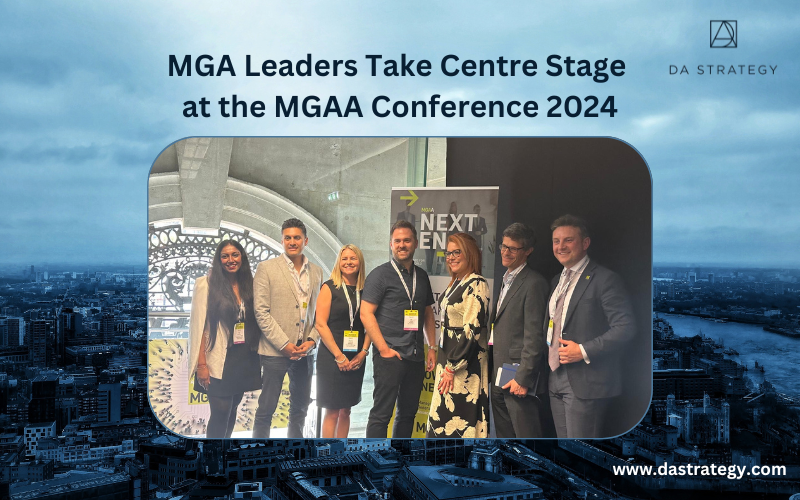

The bustling 2024 Managing General Agents Association (MGAA) Conference in July shone the spotlight on new talent with the Next Gen Breakout Session, “Next Gen does Question Time!” which saw attendees engaged with industry leaders on pivotal topics shaping the future of MGAs.
The conference room was packed with delegates, with standing room left only – testament to the intense interest in the discussion. The panel was hosted by Kaj Pankhania, Director, DA Strategy, and Chair of the MGAA Next Gen Committee, and Jack Harding, Underwriter, Miramar Underwriting, and member of the MGAA Next Gen Committee. Also, on the panel were, Charles Rowley, CEO, DA Strategy; Amy Blackshaw, CEO The Nelson Group; Ed Halsey, VP of Marketing, Genasys; Sophie Goodchild, Managing Director, Battleface UK; and finally, Devin Chawda, CEO & Co-Founder, ARMD
The lively debate covered industry adaptation, opportunities for young professionals, and the importance of cross-industry partnerships for MGAs to thrive. The first question explored strategies for how MGAs could adapt to, and navigate, the ever-evolving regulatory landscape, while promoting innovation and growth in their product offerings.
Charles reflected that, although the regulatory landscape had changed rapidly, he felt that MGAs still had the advantage of being agile and adaptable, unlike many carriers: “MGAs benefit from their flexibility in the face of regulatory changes. However, while they are nimble, they lack the large teams needed to thoroughly analyse the latest FCA regulations as quickly as larger firms.”
Ethical practices
The debate moved onto the embedding of ESG principles in MGAs and how young people could champion ethical practices and sustainability.
Kaj stressed the understanding of importance of ESG for young people especially, but questioned what more could be done to embed ESG initiatives into the senior leadership of MGAs. The panel also agreed that there needed to be a full-scale cultural change with ESG principles, across both the sector and individual companies, and that it needed to be supported from the top down or it could fall at the first hurdle. The panel collectively highlighted how the younger generation could advance this agenda by both challenging the status quo and helping to raise awareness of ESG within their organisations.
Kaj advanced the discussion by posing the question of whether companies focusing on ESG could achieve a competitive edge. The panel concurred that a top-down approach would embed this ethos into the organisational culture, potentially drawing socially conscious customers and employees who value these principles, thereby providing an advantage to MGAs.
The panel was asked if smaller, agile MGAs could lose their innovative “magic stardust” as they grow. Devin argued that learning from incumbents’ successes and mistakes allowed smaller MGAs to retain their innovative edge. With Charles adding that maintaining trust through delegation and a supportive culture was crucial as MGAs grew.
Training needs
An audience member questioned whether the industry is equipped to train the next generation according to their preferred learning styles. The panel noted the value of the MGAA Next Gen Insights Series and discussed the impact of the Covid pandemic as an alternative to face-to-face training opportunities. Kaj offered advice to leaders on starting training backwards, highlighting the end goal at the start, so that everybody knows where they need to get to.
The panel also emphasised the importance of mentorship programmes and on-the-job training, with Kaj commenting: “There are a lot of mentorship programmes within the market right now and we are not competing with each other. You can join more than one mentorship programme and reverse mentoring is also a great option. People are realising that there is power in mentorships and on the job training, but people should find their preferred learning style and what works for them.”
The panel debated the challenges of hybrid working for new insurance professionals. With Charles advocating the importance of face-to-face interaction in the office to build relationships and learn from colleagues. However, he acknowledged the benefits of flexible working arrangements, such as the “digital nomad” concept, which allows employees to work from different locations. The panel also highlighted that those not offering hybrid working may be left at a disadvantage against competitors when hiring new talent.
The session concluded with a question about whether the next generation is being given the opportunity to drive growth and innovation, or if these roles are reserved for senior management.
Charles believed that MGAs were a fantastic place to obtain exposure to a huge range of different tasks and opportunities, by working directly with entrepreneurs at the heart of the business. He commented: “It’s the fastest way to learn about insurance and MGAs are largely where the change is happening in our industry”. The panelists highlighted the importance of young people making mistakes and learning from them, stressing that they should not be afraid to make mistakes but be afraid not to learn from them.
Kaj closed the session by highlighting how we can attract talent to the industry “Everything that we do, day to day, relies on insurance and people forget that. Find out what that person’s passion is and relate it back to insurance, if they like going to galleries then what about becoming an art underwriter and so on? What we are trying to do here is make it a more fun and relatable industry for new talent.”
Many thanks to the MGAA for such an engaging and inspiring event, and for creating space for this important knowledge exchange to take place.
You may also like…

Launch of Data-Led Marine MGA Ceto
DA Strategy Supports Lloyd’s Launch of Data-Led Marine MGA Ceto

Tokio Marine HCC International, Markel and Apollo back Artio to launch early stage carbon insurance
DA Strategy Supports the Launch of Artio’s Early-Stage Carbon insurance , a data-driven early-stage carbon credit delivery insurance product

DA Strategy Supports the Launch of Volt Underwriting
DA Strategy Supports the Launch of Volt Underwriting – the new MGA bringing innovation to the energy transition sector